TRIGGER QUESTIONS :
QUESTION WORDS
PERSON WHO?
PLACE WHERE?
INFORMATION WHAT?
TIME WHEN?
POSSESSION WHOSE?
MONEY HOW MUCH?
PROFESSION WHAT DO YOU DO?
BECAUSE/REASON WHY?
MANNER HOW?
AGE HOW OLD ?
PROFESSION WHAT DO YOU DO?
OPTION WHICH?
EXISTENCE (1) THERE IS
EXISTENCE (2 OR MORE) THERE ARE
ONE (1) A / AN
SPECIFIC THE
HELPERS (PLEASE SEE AUXILARY VERBS BELOW)
ABILITY CAN
ACTIONS (VERBS) DO
CONNECTORS (PLEASE SEE PREPOSITIONS BELOW)
DIRECTION TO
LOCATION AT
Simple present tense verbs have a special form for the third person singular. Singular means "one" and plural means "more than one." Person is used here to show who or what does the action and can have the following forms:
1st person or the self (I, we)
2nd person or the person spoken to (you)
3rd person or a person not present (he, she, it, they)
The third person singular forms are represented by the pronouns he, she, it. The chart below shows how the third person singular verb form changes:
|
|
Plural | ||
| 1st Person (I) | see hear come |
1st Person (we) | see hear come |
| 2nd Person (you) | see hear come |
2nd Person (you) | see hear come |
| 3rd Person (he, she, it) | sees hears comes |
3rd Person (they) | see hear come |
Auxiliary Verbs (HELPERS)
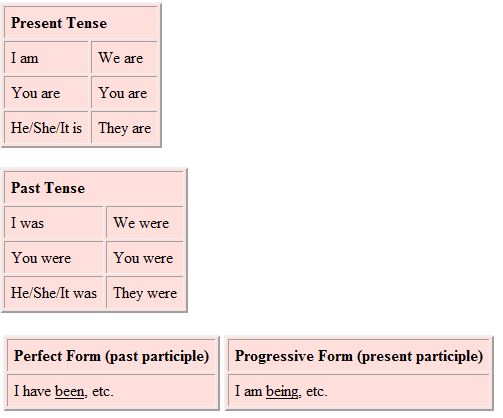
The most common auxiliary verbs are "be," "do," and "have", and you may also use these verbs on their own. You use "Will" and "shall" to express future time.
In each of the following examples, a verb commonly used as an auxiliary verb appears as a simple predicate:
- She is the chief engineer.
- The tea cups are in the china cabinet.
- Garth does this kind of thing frequently.
- My roommates and I do the laundry every second week.
- I can't complete my assignment because he still has my notes.
- They have several kinds of gelato in the display case.
Other common auxiliaries are "can," "could," "may," "might," "must," "ought," "should," "will," and "would." A verb like these is called a modal auxiliary and expresses necessity, obligation, or possibility.
The highlighted word in each of the following sentences is a modal auxiliary:
- Zora was pleased to learn that she could take several days off.
- The small freckled girl told her neighbours that she would walk their dog for an appropriate fee.
- Henry told Eliza that she ought to have the hole in the bucket fixed.
- The principal told the assembled students that the school board might introduce a dress code next autumn.
- According to the instructions, we must leave this goo in our hair for twenty minutes.
Several words may intervene between the auxiliary and the verb which goes with it, as in the following sentences:
- They have not delivered the documents on time.
- The treasure chest was never discovered.
- The health department has recently decided that all high school students should be immunised against meningitis.
- Will you walk the dog tonight?
- The ballet corps was rapidly and gracefully pirouetting about the stage.
What? Que / Cual *
What time? Que hora / A que hora
What colour? Que color
What nationality? Que nacionalidad
What ............like? Como (para describir algo a alguien)
What ............for? Para que
Where? Donde
Where...........from? De donde
When? Cuando
Which? Cual *
How? Como (generalmente para salud o estado de ánimo)
How old? Como de viejo ( para la edad)
How much? Cuanto/a
How many? Cuantos/as
How often? Con que frecuencia
How long? Como de largo
How long? Cuanto tiempo
How far? Como de lejos
Who? Quien
Who............for? Para quien
Who............with? Con quien
Whose? De quien
Why? Por que (se responde con because.....)
* What / Which? significan cual o cuales pero usamos "what" cuando tenemos muchas opsiones para elegir y "which" cuando el número de elecciones es limitado o pequeño.
Ejemplos
What´s this?
What´s your name?
What time is it?
What time do you get up?
What colour is your car?
What nationality are you?
What is Tres Arroyos like?
What is a screwdriver for?
Where are the children?
Where do you come from?
When is your birthday?
Which colour do you like red or blue?
How are you today?
How old is your mother?
How much does a sweater cost?
How many books are there on the floor?
How often do you go to church?
How long is the River Nile?
How long are you going to stay in Buenos Aires?
How far is your house from the city centre?
Who is that man?
Who do you work for?
Who do you live with?
Whose jeans are these?
Why do you study English?
|
PREPOSITION (CONNECTORS)LIST Movement Movimiento |
|
|
|
about |
por (alguna parte) |
abáut |
|
across |
a través de, de un lado al otro |
akrós |
|
along |
a lo largo de |
alóng |
|
(a)round |
alrededor de |
aráund, ráund |
|
as far as |
hasta (un lugar) |
as far as |
|
(away) from |
lejos de, distante de |
euéi from |
|
back from |
de regreso de |
bak from |
|
between |
entre (dos objetos o personas) |
bituín |
|
by |
en, por medio de |
bái |
|
down |
hacia abajo |
dáun |
|
in(to) |
en, dentro de |
ín(tu) |
|
off |
a cierta distancia de |
of |
|
on(to) |
en, sobre, a |
ón(tu) |
|
out of |
fuera de |
áut ov |
|
over |
por encima, durante, al otro lado |
óuver |
|
past |
pasado, pasadas (hora) |
past |
|
through |
a través de, por |
zrú |
|
to |
a, hacia |
tu |
|
toward(s) |
hacia |
tóua:rd(s) |
|
under |
debajo de |
ánder |
|
up |
arriba |
ap |
|
Position |
Posición |
|
|
about |
sobre, acerca de |
abáut |
|
above |
por encima de, más arriba de |
abáv |
|
against |
contra |
eguéinst |
|
amid(st) |
entre, en medio de |
amíd(st) |
|
among(st) |
entre (más de 2 cosas o personas) |
amóng(st) |
|
(a)round |
alrededor |
aráund, ráund- |
|
at |
en |
at |
|
before |
antes de |
bifo: |
|
behind |
detrás de |
bijáind |
|
below |
debajo de |
bilóu |
|
beneath |
bajo, debajo de |
biníz |
|
beside |
al lado de |
bisáid |
|
between |
entre (2 cosas o personas) |
bituín |
|
in |
en, dentro de |
in |
|
in front of |
delante de, ante |
in front ov |
|
inside (UK) |
dentro de |
insáid (UK) |
|
near |
cerca de |
níar |
|
next to |
al lado de, junto a |
néks-tú |
|
off |
de, separado de |
of |
|
on |
sobre |
on |
|
opposite |
enfrente de |
óposit |
|
underneath |
debajo de (en la parte inferior) |
ánderniz |

